
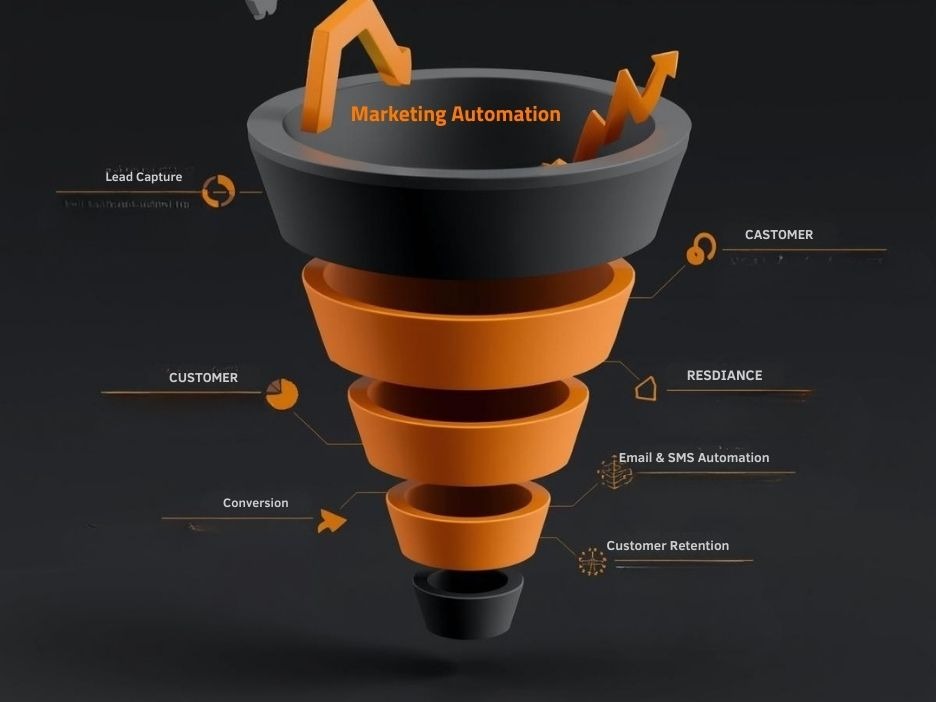
Marketing automation is no longer a luxury reserved for enterprise brands. In today’s hyper-competitive digital landscape, marketing automation has become the foundational infrastructure behind every scalable, data-driven business. Whether you are a growing startup or an established company, Automated marketing is the system that connects your entire revenue operation, from the first moment a prospect discovers your brand to the long-term relationship that turns them into a loyal advocate.
According to Grand View Research, the global marketing-automation market was valued atUSD 6.65 billion in 2024 and is projected to reach USD 15.58 billion by 2030. That growth reflects a fundamental shift in how businesses operate. Companies using Automated marketing experience an increase in qualified leads of up to451%, while achieving a 544% return on investment over three years, according to Nucleus Research. These are not marginal gains; they are the kind of transformative outcomes that separate market leaders from everyone else.
This guide walks you through the complete marketing automation journey, from lead capture to customer retention, and explains exactly why now is the time to invest.
What Is Marketing Automation?
At its core, marketing automation refers to software and technology platforms that execute marketing tasks, campaigns, and workflows automatically, without requiring manual action at every step. Automated marketing systems use behavioral triggers, CRM data, lead scoring models, and AI-driven personalization to communicate with prospects and customers across email, web, social media, and SMS channels simultaneously.
The difference between basic scheduling tools and true Automated marketing is intelligence. A marketing automation platform does not just send messages on a timer; it listens to what your prospects and customers are doing, learns from their behavior, and responds with the right message at the right moment. That level of precision is what makes Automated marketing one of the highest-leverage investments any business can make in its growth infrastructure.
Marketing-automation also eliminates the manual, repetitive tasks that consume the time of your marketing and sales teams, freeing them to focus on strategy, creativity, and the high-value conversations that actually move deals forward. When implemented correctly, marketing automation does not replace your team; it makes your team dramatically more effective.
1: Lead Capture, The Starting Point of Every Marketing Automation Journey
Every successful marketing automation strategy begins with lead capture. Without a steady, qualified flow of leads entering your system, even the most sophisticated marketing-automation workflows will have nothing to work with. Lead capture is where Automated marketing first proves its value, by replacing slow, manual processes with intelligent, always-on systems that work around the clock.
Marketing automation platforms integrate directly with your website forms, landing pages, chatbots, and social media lead ads to capture prospect data the moment it is submitted and route it instantly into your CRM and nurture workflows. Progressive profiling, a technique built into most Automated marketing systems, allows forms to gather additional information over multiple visits rather than overwhelming a first-time visitor with a long form. This keeps friction low while building increasingly rich lead profiles over time.
Lead scoring is another critical component of Automated marketing at the capture stage. Rather than treating every lead equally, marketing automation assigns numerical scores based on demographic fit, firmographic data, and behavioral signals, pages visited, content downloaded, pricing pages viewed, and emails opened. When a lead crosses a defined score threshold, the marketing-automation system automatically classifies them as a Marketing Qualified Lead and routes them to the sales team for immediate follow-up. This ensures your sales team spends their time only on prospects who are genuinely ready to engage.
2: Lead Nurturing, Where Marketing Automation Builds Relationships at Scale
The majority of leads that enter your Automated marketing system are not ready to buy immediately. Research consistently shows that B2B buyers consume multiple pieces of content before making a purchase decision, and marketing automation is what makes it possible to deliver that content journey in a personalized, timely, and scalable way.
Marketing automation nurture programs use drip email sequences, behavioral retargeting, dynamic website content, and personalized recommendations to guide prospects through every stage of the buyer journey. Each action a prospect takes, opening an email, visiting a product page, downloading a whitepaper, triggers the next step in the marketing-automation workflow, creating a seamless experience that feels personal even when it is running entirely on autopilot.
Email remains the highest-ROI channel within any marketing automation strategy. Automated email workflows built inside an automated marketing platform, welcome sequences, educational drips, behavior-triggered campaigns, and re-engagement series consistently outperform manually sent campaigns because they reach prospects at the exact moment of peak interest. Marketing automation makes it possible to run dozens of these sequences simultaneously across different audience segments without adding headcount.
The compounding effect of good marketing automation nurturing is significant. Prospects who receive consistent, relevant, personalized communication through a marketing automation system convert at higher rates, buy more quickly, and enter the sales conversation with a much stronger understanding of your value proposition, making every sales call more productive.
3: Sales Alignment, Connecting Marketing Automation to Revenue
One of the most powerful and often underutilized benefits of marketing automation is its ability to bridge the gap between marketing and sales. In organizations withoutAutomated marketing, leads frequently fall through the cracks. Marketing generates them, but sales don’t follow up in time, or follow up without context. Marketing automation eliminates this problem.
When marketing automation is integrated with your CRM, every lead handoff becomes seamless and data-rich. The sales team receives an automatic notification the moment a lead reaches MQL status, complete with a full timeline of every interaction that lead has had with your brand. They know exactly which pages the prospect visited, which emails they opened, and which content they downloaded, giving them a genuine conversation starter rather than a cold introduction.
Marketing automation also keeps deals moving through the pipeline by triggering automatic follow-up reminders, re-engagement sequences for stalled opportunities, and post-meeting nurture emails that reinforce key messages. The result is a sales process that moves faster, wastes less time, and closes at a higher rate, all powered by the same marketing automation infrastructure that captured and nurtured the lead in the first place.
4: Customer Onboarding, Using Marketing Automation to Secure Long-Term Loyalty
Winning a new customer is only the beginning of the marketing automation journey. The onboarding period, the days and weeks immediately following a purchase or sign-up, is the most critical window for establishing the kind of loyalty that drives long-term retention. Marketing automation allows businesses to design and deliver sophisticated onboarding experiences that guide every new customer to their first meaningful success moment.
A well-designed Automated marketing onboarding sequence might include a personalized welcome email series, in-app behavioral triggers that deliver guidance exactly when a user needs it, milestone celebration messages that reinforce positive progress, and proactive check-ins timed to prevent common friction points. Every element of this experience is delivered automatically by the marketing automation system, ensuring consistency at scale regardless of how many new customers you are onboarding simultaneously.
For SaaS businesses, e-commerce brands, and subscription services, especially, marketing automation at the onboarding stage is directly correlated with reduced churn and increased lifetime value. Customers who reach their first success moment quickly are significantly more likely to remain subscribers, make repeat purchases, and recommend your product to others.
5: Customer Retention, The Long-Term Payoff of Marketing Automation
Customer retention is where marketing automation delivers its most compelling long-term return. Acquiring a new customer costs significantly more than retaining an existing one, making every percentage point of improved retention directly impactful to your bottom line. Automated marketing makes systematic, scalable retention possible in a way that manual processes simply cannot achieve.
Marketing automation retention programs work by continuously monitoring customer behavior for signals of disengagement, declining usage, reduced email opens, missed renewal dates, unanswered support tickets, and automatically triggering personalized interventions designed to re-engage the customer before they churn. Win-back campaigns, loyalty reward notifications, product update announcements, anniversary messages, and satisfaction survey sequences are all standard components of a mature marketing automation retention strategy.
The businesses that invest in Automated marketing retention workflows do not just reduce churn; they build a compounding base of loyal customers who generate referrals, leave positive reviews, and contribute to organic growth that no paid acquisition channel can replicate. Over time, the marketing automation system learns which interventions work best for which customer segments, continuously improving retention outcomes through data-driven optimization.
The Future of Marketing Automation: AI and Hyper-Personalization
The next frontier of marketing automation is being shaped by artificial intelligence. AI-powered Automated marketing systems can now analyze customer behavior in real time, predict which leads are most likely to convert, recommend the optimal next action for every contact in your database, and automatically optimize campaign performance without human input. The convergence of AI and Automated marketing is making hyper-personalization, delivering a genuinely unique experience to every individual, achievable at enterprise scale.
Businesses that invest in AI-enhanced marketing automation today are building a structural advantage that will compound over the years. As their systems learn more about their customers, marketing automation outcomes will continue to improve, creating a widening gap between automation-first businesses and those still relying on manual processes.
Conclusion
Marketing automation is the single most scalable investment a modern business can make in its revenue infrastructure. From the intelligent capture of leads at the top of the funnel, through personalized nurturing and seamless sales alignment, to onboarding experiences and retention programs that build lasting loyalty, marketing automation connects every stage of the customer lifecycle into one coherent, measurable, and continuously improving system.
The market data confirms what leading businesses already know: USD 15.58 billion in projected market value, 544% documented ROI, and 451% average increase in qualified leads. Marketing automation is not a trend. It is the foundation of every competitive growth strategy operating at scale today.